









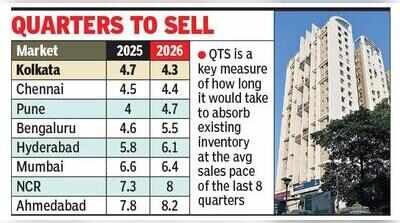
Kolkata: Kolkata has recorded the lowest residential inventory overhang in the country with its unsold housing stock declining sharply in Q3 2026. However, this is not due to a sudden spurt in demand or effective marketing by real estate agents. Instead, it is due to a significant decline in project launches this year.TOI has reported how project launches have been impacted due to civic clearance issues since Feb 2026 due to the polls and the subsequent change in govt. Though KMC has recently approved over a dozen projects, many more are hanging in the balance.According to real estate consultancy firm Knight Frank India, the city’s quarters to sell (QTS), a key measure of how long it would take to absorb existing inventory at the average sales pace of the last eight quarters, declined to 4.3 quarters in Q3 2026 from 4.7 quarters in Q3 2025. In annual terms, this means Kolkata now requires just 1.07 years to clear its current unsold residential inventory, compared with 1.17 years a year earlier.This improvement was driven primarily by controlled supply. While average residential sales remained steady during the period, the sharp decline in new launches ensured that sales exceeded fresh additions to the market. As a result, unsold inventory in Kolkata reduced by 10% over 12 months, falling from 20,033 units in Q3 2025 to 18,111 units in Q3 2026.Kolkata’s performance stands out at a time when the broader Indian residential market is seeing a slight lengthening in the absorption cycle. Across the top eight markets, the average QTS edged up to 6.1 quarters in Q3 2026 from 5.8 quarters in Q3 2025. Even so, the national inventory position remains healthier than the elevated levels seen between 2018 and 2021, when QTS ranged between seven and 11 quarters.Compared with other major cities, Kolkata’s lean inventory profile reflects a more disciplined development environment. Markets such as Ahmedabad, NCR, Hyderabad, Bengaluru and Pune witnessed higher QTS levels due to either stronger launch activity or softer sales momentum. Kolkata, in contrast, benefited from a better balance between demand and supply, with developers exercising caution in adding new stock.The reduction in unsold homes also signals improved market stability. Lower inventory overhang can support healthier pricing, reduce pressure on developers and improve buyer confidence by limiting the risk of excessive supply. With the city requiring the least time to absorb its existing stock, Kolkata’s residential market continues to demonstrate resilient fundamentals.Knight Frank India’s data indicates that Kolkata’s disciplined supply strategy has helped it outperform larger and faster-growing markets, positioning the city as the most inventory-efficient residential market in Q3 2026.