
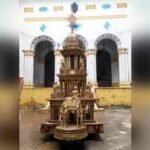







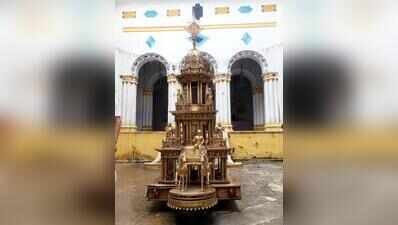
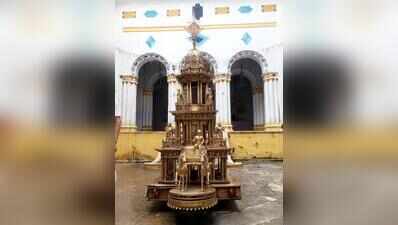
Kolkata: A 250-year-old brass chariot, a library born of the freedom struggle and the delicate art of Bengali alpana have taken centre stage as the Purono Kolkatar Golpo Society (PKGS) is celebrating World Heritage Week. The society felicitated their custodians — the Tarak Nath Pramanik family, Jadavpur’s Vidyarthi Pathagar, and artist Ratnaboli Ghosh — for keeping Kolkata’s tangible and intangible heritage alive.PKGS’s Swarnali Chattopadhyay said: “We honoured the Tarak Nath family for keeping alive the brass rath, a treasured heirloom and a symbol of the city’s cultural and spiritual heritage. The Pathagar serves as a cornerstone of our educational heritage and nurtured a culture of learning for decades. Ratnaboli-di has been felicitated for her contribution to preserve the intangible cultural heritage of alpana and propagating it.”Commissioned by Gurucharan Pramanik — son of Madanmohan Pramanik, who ran a bell-metal and brass factory — at 154 Tarak Pramanik Road, the chariot carries only his household deity, Sridhar Narayan, unlike traditional rath yatras.“The unique three-tiered chariot is 12-13 feet tall. Local artisans built it but its structural design was created by the British, who repurposed European maritime motifs — featuring winged angels, Ionic pillars, and Victorian-gowned figurines — with subtle Indian touches. A week before Rath Yatra, the family reassembles it using techniques passed down through generations,” said ninth-generation descendant Soumitra Pramanik.Vidyarthi Pathagar began during the 1928–1930 freedom struggle as Chatri Sangha Pathagar, founded by revolutionaries Bina Das, Kalyani Das, and Kamala Dasgupta. After several relocations, it moved to Central Park in 1959 and secured a permanent home at 11B, Central Park in 2018.Library secretary Suman Dhar said, “In 1959, Dhira Dhar (Kalyani’s niece) and husband Samar Dhar brought it to Central Park, Jadavpur. In its long journey, the library traversed troubled waters and even neared closure; however, it was revived mainly by Dhira, volunteers, and community support. It houses rare volumes like Modern Review, Basumati, and Bharatbarsho, some still bearing blue-ink Chatri Sangha labels. Today, it opens on Mondays and Thursdays and hosts cultural events.”A septuagenarian former teacher, Ratnaboli Ghosh, who preserves hand-painted alpana, was also honoured. “Growing up, alpana was always part of my life because my mother studied under Nandalal Bose at Santiniketan. Though I never received formal training, I was deeply familiar with it. It feels wonderful to see others taking up alpana, and I am deeply humbled to know they have been inspired by me,” said Ghosh.