









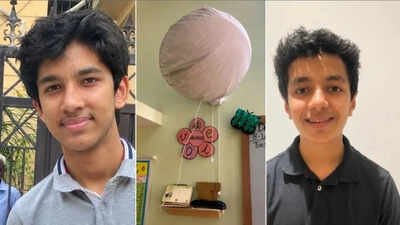
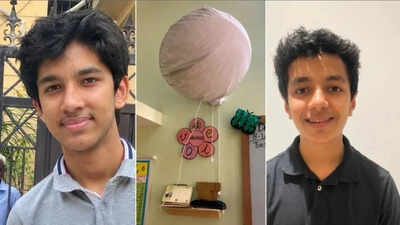
NEW DELHI: Switch on the fan and the white fabric swells like a balloon. Leave it in use for a few weeks and it can turn grey, sometimes black. For two Delhi teenagers, that change in colour is the most visible sign of what their Rs 140 filter is designed to do: trap some of the fine particles that children would otherwise breathe in while sitting through lessons.Krish Aggarwal, a Class XII student at Sanskriti School, and Samarth Meattle, a Class XI student at Vasant Valley School, started Project Vayu with a question that had as much to do with school budgets as with Delhi’s air: what could classrooms that could not afford air purifiers use instead? Their answer was something many schools already had — a fan.For Aggarwal, who has earned a place on the 2026 Diana Award Roll of Honour, the idea began at home. “I have lived all my life in Delhi and I used to have nosebleeds every single day,” he said. He recalled that the nosebleeds stopped after he got an air purifier for his room. He and his cousins began thinking about children facing similar problems and examined what made air purifiers expensive. Two of the biggest costs, they found, were the fan and the air-filtering material.
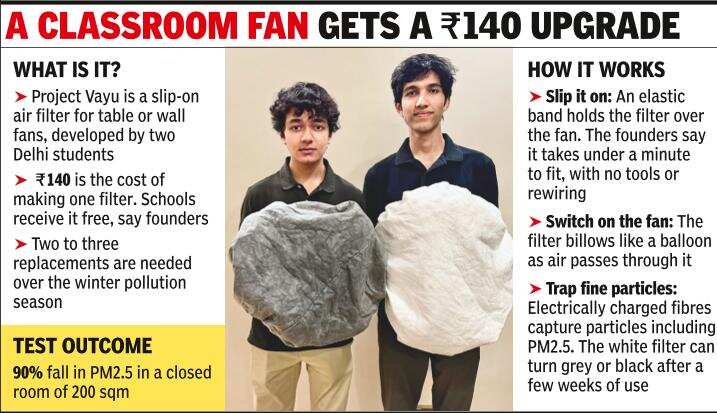
Meattle said using a table or wall fan already available in classrooms helped keep costs down. An elastic band holds the filter in place as the fan pushes room air through the fabric, which traps fine particles, including PM2.5.“As the air circulates, it passes through the filter again and again. For the project, Hollingsworth & Vose supplied the filter material free of cost in large rolls, which were then cut to size and fitted with elastic at a factory,” Aggarwal said, explaining how the project kept costs low.The students found their first opportunity through an NGO that tested the filter and helped them conduct a pilot across 295 classrooms, reaching about 8,000 students. Meattle said the classrooms were equipped with air-quality monitors, and schools were asked to record readings every hour.In classrooms measuring roughly 600-700 sq ft, the model can reduce PM2.5 levels by 50-55% in the first hour and around 90% after several hours of use, Aggarwal said. In a 200 sq ft room, the team estimated a reduction of around 90% within an hour. “A classroom is harder to control, with doors opening and closing through the day. If the windows are open, you can’t expect to get those results,” he said.The young innovators now aim to reach 15,000-20,000 students across around 10 schools. “We are looking at ways to get them tested at govt schools so more students benefit from this,” Aggarwal said.