










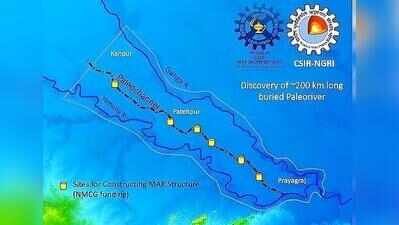

Prayagraj: Long lost to the sands of time, the ancient rivers of Uttar Pradesh could soon find their way back onto the map. In a bid to reconnect with the state’s forgotten river heritage and strengthen water conservation, efforts are underway to trace the palaeo-channels — the buried courses of rivers that once flowed through the region — including that of the ancient Saraswati.The Yogi govt has taken up the initiative as part of its ongoing push for water conservation and revival of lost rivers. The groundwater department has launched a pilot project to identify the ancient course of the Saraswati.Though described as a real river in ancient and mythological texts, the Saraswati’s original course is no longer visible. Scientists have identified a 200-km palaeo-channel believed to be associated with the river, and efforts are now underway to explore its revival. To take the initiative forward, the groundwater department has launched a pilot project worth Rs 1.6 crore.Rajesh Kumar Prajapati, director, groundwater department, explains that the project is receiving financial support from National Mission for Clean Ganga (NMCG) and technical assistance from National Geophysical Research Institute (NGRI). He adds that an initial survey was conducted in 2022, which serves as the foundation for the current project. Through geophysical surveys and borehole investigations, NGRI scientists have identified the ancient river course, which, in some locations, is estimated to be up to five km wide.The project will be implemented in three phases. The 200-kilometre-long river course contains significant layers of sand and gravel, which facilitate the percolation and storage of water.Subhash Chandra, an NGRI scientist overseeing the technical aspects of the project, states that this study will help in understanding the groundwater reserves and the nature of ancient river courses beneath Ganga-Yamuna ‘Doab’ (the land between the two rivers). Work has already commenced in the first phase at six locations across Kanpur, Kaushambi and Fatehpur. More than 150 sites will be identified for this project. A decision regarding its expansion will be made based on the outcome of the pilot project.Prajapati, meanwhile, claims that the objective of this project is to prevent rainwater from going to waste through runoff and, instead, use it to recharge groundwater reserves. He points out that the study will help in understanding the state of the aquifers and ancient river channels lying beneath Ganga-Yamuna Doab region. Based on this, suitable locations for groundwater recharge are being selected.This project could, on the one hand, reveal significant information regarding the existence of the ancient, sacred Saraswati river, while on the other it may offer a permanent solution to the water crisis in the region’s rivers.Prajapati said: “An on-ground action has commenced following a preliminary survey conducted in 2022.” The presence of sand and gravel layers underground facilitates the rapid absorption of rainwater. The project will also help determine how rainwater—which otherwise goes to waste as runoff—can be directed to recharge these vast, natural underground water reservoirs.The selected region, spanning from Kanpur to Prayagraj, could see its declining groundwater levels stabilised. Additionally, based on the results of this pilot project, govt may consider extending the initiative to other ancient geological water channels across the state. This endeavour by the UP govt will not only breathe new life into a river that serves as a symbol of faith but will also ensure water security for future generations.