









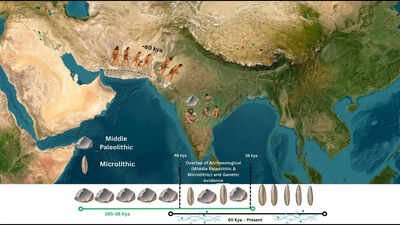
PRAYAGRAJ: The centuries-old links between India and Southeast Asia are often traced through the Chola Empire, the spread of the Ramayana or monuments such as Cambodia’s Angkor Wat. But a new genetic study has pushed that connection back far beyond recorded history — by nearly 50,000 years.Scientists have found genetic evidence that early humans who migrated out of Africa into the Indian subcontinent later travelled along an ancient southern route to Sri Lanka, Thailand and Indonesia, establishing a continuing human connection between South and Southeast Asia thousands of years before the rise of civilisations.The study, published in the scientific journal Mitochondria by Elsevier on Nov 13, analysed mitochondrial DNA, which is inherited through the maternal line, to trace the evolution of haplogroup R30. The research involved 14 researchers from six institutions across India, Australia, the US and Iraq, including Banaras Hindu University (BHU), Vellore Institute of Technology, Mangalore University, Griffith University, the University of Queensland, the Smithsonian Institution and institutions in Baghdad.Scientists analysed 198 modern and ancient DNA sequences, including 44 samples from Amini Island in Lakshadweep. The wider dataset covered populations from India, Lakshadweep, Sri Lanka, Pakistan, Iran, Thailand, Indonesia, Tibet and China, allowing researchers to reconstruct the distribution and evolution of the R30 maternal lineage.Lead author Shailesh Desai of Gyan Lab, BHU, said the most significant finding was evidence of prolonged genetic contact between the Indian subcontinent and Southeast Asia, rather than a single migration event.“The R30 lineage shows that human movement from India towards Southeast Asia continued over thousands of years. One branch diverged from the Indian population around 45,500 years ago and subsequently reached Thailand, while another lineage moved towards Indonesia around 27,000 years ago,” he said.Prof Gyaneshwer Chaubey of BHU said the findings place India at the centre of the evolution and dispersal of the R30 lineage.“The roots of this major haplogroup, which is now found in Southeast Asia, lie in the Indian subcontinent. This lineage originated in India nearly 50,000 years ago and provides a clear genetic link between South Asia and Southeast Asia through an ancient southern route,” he said.The study suggests that R30 first developed in North India around 44,000 years ago. Around 16,700 years ago, as climatic conditions changed following the peak of the last Ice Age, populations carrying the lineage appear to have moved towards South India in search of favourable environmental conditions and resources before expanding further towards Southeast Asia.The research also offers clues about ancient human movement to Sri Lanka and the Lakshadweep islands. R30-related lineages were identified among the Vedda of Sri Lanka, the Urali Kuruman community of South India, and populations of Amini and Chetlat in Lakshadweep. Researchers estimate that humans reached Sri Lanka around 11,000 years ago, while settlement of Lakshadweep began around 5,400 years ago.Prof Michael Petraglia of Griffith University, Australia, said the findings reinforce the importance of the Indian subcontinent in the wider dispersal of modern humans following their migration out of Africa. The researchers also point to possible interactions between Homo sapiens and archaic human populations in South Asia, with Middle Palaeolithic stone-tool evidence suggesting possible exchanges of technology.The study positions India not merely as an early destination for humans migrating out of Africa, but also as a major staging ground from which successive populations expanded towards Sri Lanka, Lakshadweep and Southeast Asia.